
By Louise Joachimowski
March 26, 2025
Early childhood education is emerging as one of the most important areas of helping families to overcome poverty. Every year a child spends in school increases their chances of not living their life in poverty, and preparing children for school early increases the chance that they will remain in school!
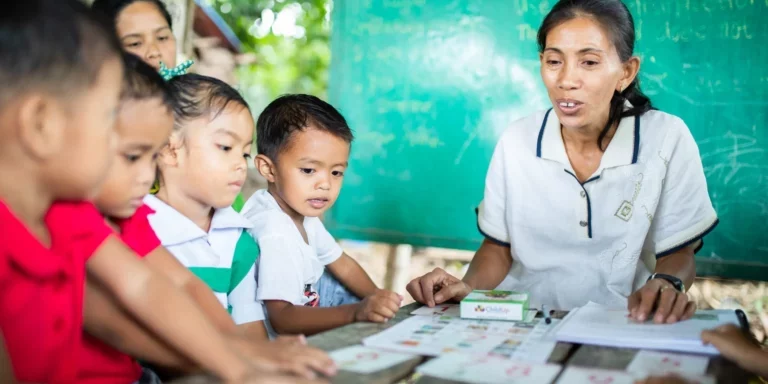
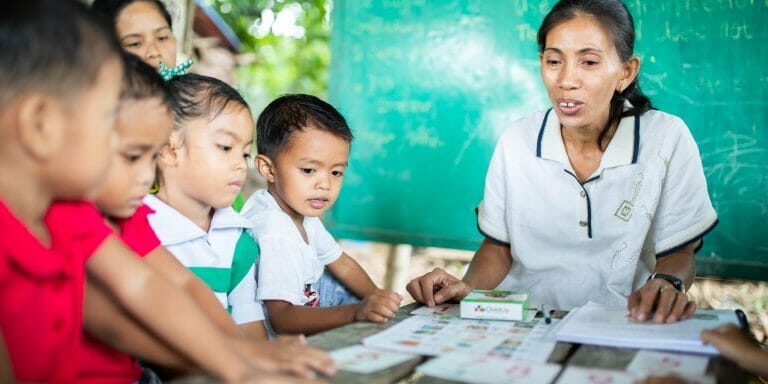
ICM’s Family Academy aims to do just that. This low-cost, scalable program teaches three-five year olds at home, encouraging their parents to become their children’s first teacher, alongside a volunteer coach who coaches both the parent and the child. And now ICM has research to prove the strategy’s impact for children, in the form of a recently published Randomised Controlled Trial, led by researchers from Oxford University, Innovations for Poverty Action, Pepperdine University, and ICM.
The paper, entitled ‘Human Capital at Home: Evidence from a Randomized Evaluation in the Philippines’, suggests, “Greater parental engagement with their children’s education in low-income settings may be a promising path to realizing untapped human capital”. ICM is pleased to report that Family Academy is proven to greatly improve children’s math and phonics (pre-reading) skills, and for a fraction of the cost of similar strategies.
“Realizing untapped human capital” sounds clinical, and necessarily so for an academic paper. So, let’s put it into layman’s terms – research has shown when mothers and fathers are encouraged and supported to teach their pre-school aged kids, the skills, talents, and creativity of those little people will one day benefit not only themselves, but their communities, and perhaps even the world. In other words, ICM’s Family Academy is releasing children from their previously limited futures.
Most people assume a child is educated through their academic institution – their pre-school, primary school, or high school – but most of a child’s time, and therefore learning potential, is spent in their home, with their families. In high-income communities, parents often support their children and therefore leverage their ‘at-home’ time, for example, through reading books with children as toddlers, or helping with homework as they grow. However, in low-income communities, parent involvement is much lower (often due to a parent’s own levels of literacy), which exacerbates the gap in learning outcomes for children within these communities. Correcting this disparity can enable students from low- and middle-income countries to close these substantial learning gaps.
The lead author of this study, Noam Angrist, is the Academic Director of the What Works Hub for Global Education and Senior Fellow at the University of Oxford. Keen to discover ‘what works’ within the early childhood intervention sector, he and his colleagues conducted a randomized controlled trial promoting parental involvement in their children’s education with over 1,000 households involved with ICM’s Family Academy. The program provides numeracy and phonics instruction for children aged 3 to 5 years of age, and focuses on coaching parents to become active participants in their children’s education with a “tell-show-do” methodology – an ICM coach introduces a learning activity, demonstrates it and then invites the parent to lead that activity.
The results were not only pleasing, they were impressive. Angrist reports, “Family Academy improves learning outcomes substantially, by 0.52 and 0.51 standard deviation gains in numeracy and phonics skills.” Not only were these initial assessments promising, they also showed persistence over time, with a 0.15 standard deviation for math skills (p=0.06) and 0.13 standard deviation for phonics (p=0.12) when children were assessed over a year later.
When compared with other education interventions this is outstanding (sadly, more than half of reported education interventions have no positive long-term effect, with the median effect being 0.1 standard deviations). Angrist translated these results (for those of us not as au fait with statistical studies), explaining, “getting to 0.2 or 0.4 is a really big deal” (emphasis his). The paper concludes, “Our results show that parents can substantially improve basic numeracy and phonics skills, even in a low-resource setting, maximizing the chances that their children have the required foundational skills to benefit from primary school instruction.”
The study also allowed for an additional observation regarding the role of women in education and the labor market, that is, if a mother engages in her child’s education will her ability to participate in paid work be negatively impacted? This question has been investigated in high-income communities, but very little work has been done among low-income countries. Angrist and his team were able to determine that even with an increase in time spent on their child’s education, parents’ paid work was not significantly affected.
In a recent interview with ICM, Angrist was enthusiastic for not only the results so far, but what lies ahead. He shared, “Usually when I’m involved with running a randomised study, I have to be pretty hands on because it’s very complicated…you know, the [ICM] team was so strong, I could kind of come in and say, what about this, what about that, and then it was handled, it was really a treat as a researcher…for me it was easy…whenever something’s easy you know that someone’s putting in a lot of great work… Of the organisations I’ve worked with this was probably one of the smoothest research experiences I’ve had…the ICM team has not only the implementation but the research capacity, one of the co-authors on the study is part of the ICM team [Lincoln Lau], I think that’s the way of the future, I think we want more things like that going forward where it’s a combination of the implementation and research teams that are really part of the write up of the work.”
Whether we call it “realizing untapped human capital” or releasing children from their previously limited futures, ICM is gratified to see that for just over $50 per child, Family Academy is making a concrete difference in children’s educational abilities!
—
Want to help children on their path to a brighter future? $50 can educate a child! Donate here.
—
To read the full RCT write-up, click here.
About the Author

Louise Joachimowski
With a passion for storytelling, a love for the poor, and sharp eye for analysis, Louise is ICM’s Hong Kong Executive Director. Since 2010, Louise has served ICM in Bacolod City and Hong Kong, as well as traveling the world to share ICM’s work. Spending literally thousands of hours alongside the ultra-poor and hearing their stories, she loves nothing more than sharing the stories of heroism and hope that ICM participants have to tell, whether through music, video, writing or photography.
Did you know? ICM delivers Transform for just over US$10 per person.
Consider your support
Please partner with ICM today to bring help, hope and change.
The ICM community is full of people who care about effective, efficient, research-backed solutions in the fight against ultra-poverty. We would love to have you join us!
Stay in touch
Stay up-to-date on news, programs, and more by joining the ICM community.